
news / News
Promised school, compelled work: labor trafficking inside ordinary households
A recent State Department account revisits a Chicago case affirmed on appeal in August. The record shows how promises of opportunity gave way to years of work, isolation and fear.
Source review: 2026-11-05
Two children came from Benin to the Chicago area after their families were promised education and a better future. The adults who brought them instead kept them out of school and made them work in homes and a hair-braiding salon, controlling them through violence, isolation and fear of the outside world.
A State Department account published October 26 has brought renewed attention to that labor-trafficking case. The convictions are older: a jury returned verdicts in January 2024, and the defendants were sentenced that September. The Seventh Circuit affirmed the convictions and sentences on August 13, 2026.
The case matters because the work happened in familiar settings. Childcare, laundry, cooking and salon work became part of a system in which children were denied meaningful choices and made afraid to seek help. The record establishes much more than long hours or a broken promise.
The promise and the daily reality
According to the appellate opinion, Nawomi Awoga and her daughters, Marina Oke and Assiba Lea Fandohan, arranged for the children to enter the United States in 2014 using false identities and a fabricated family story. One family was told their child would attend school. The other was offered schooling and an opportunity to learn salon work. Existing family and community connections helped make the arrangements appear trustworthy.
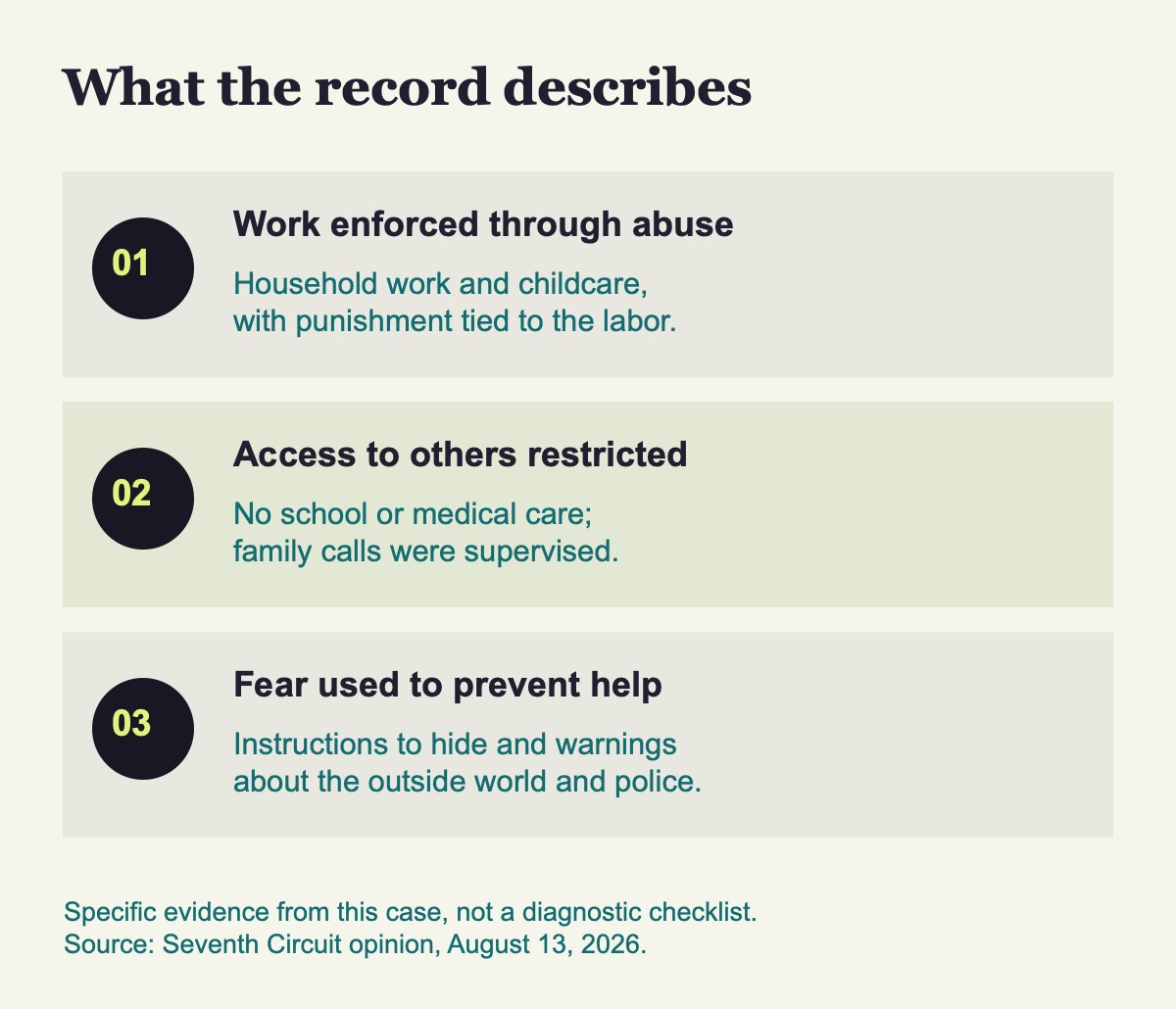
After arrival, the children were separated into two households in the Chicago suburbs. They cleaned, cooked, washed clothes and cared for the defendants’ children. One was expected to work late into the night and begin again early the next morning. Neither attended school or received medical care, even though the defendants’ own children did. The opinion recounts testimony about repeated physical punishment tied to the work. Opinion, pages 2–6.
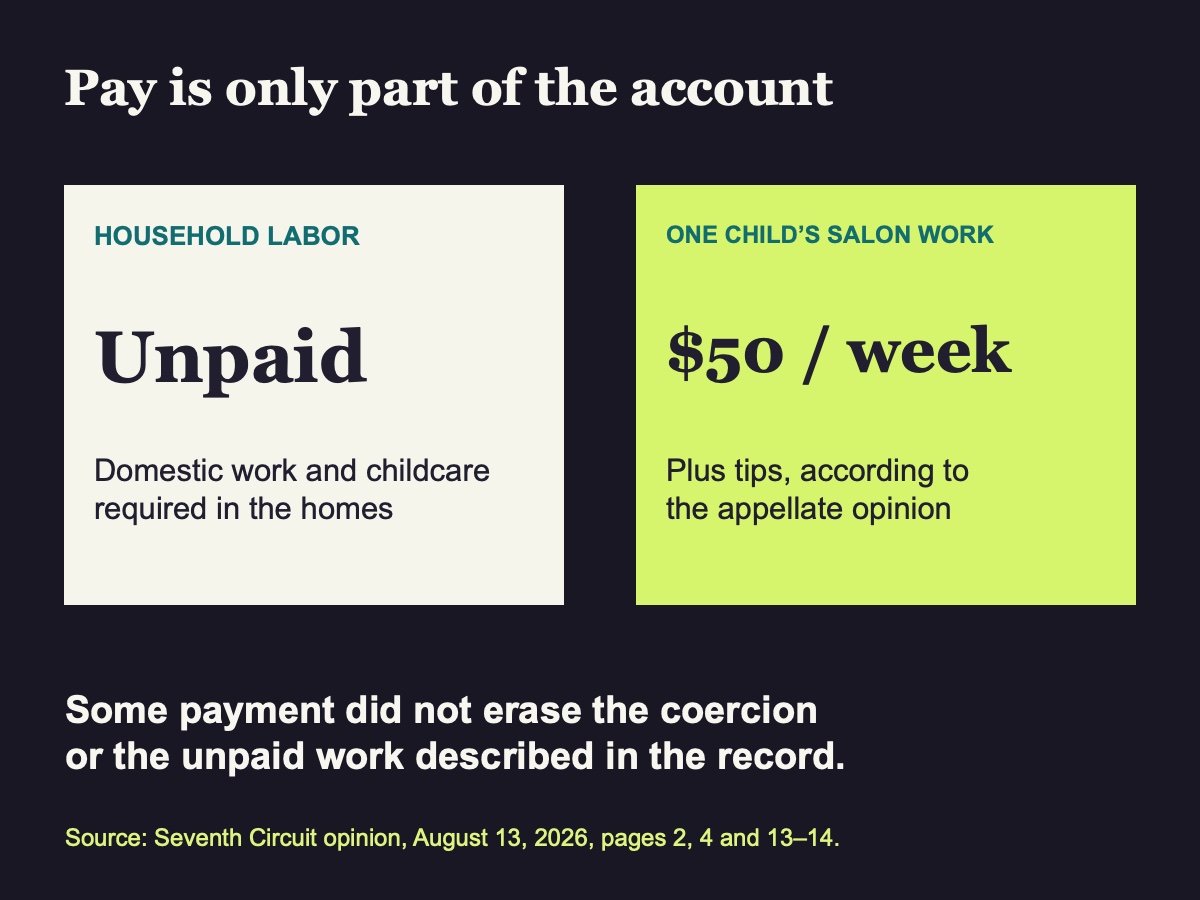
The pay requires care. The household labor was unpaid. One child also worked at Oke’s hair-braiding salon and received $50 a week plus tips for that salon work. The State Department’s broad description of work without pay should be read alongside that more detailed court account. Receiving some money did not erase the coercion, the unpaid domestic labor or the conditions the jury heard about.
That distinction helps explain why a familiar arrangement cannot be assessed simply by asking whether any payment changed hands. The questions include what work was required, how it was compelled and what happened when a person tried to refuse.
Control reached beyond the home
The opinion describes restrictions that made outside help harder to reach. Calls to family were supervised. One child was told to hide from visitors; another was told to hide when police approached the salon. The children were taught to fear people outside the household and, in one child’s case, to believe police would return her to Benin. Trips outside could still involve caring for the defendants’ children.
These details explain why being seen in public is not proof that someone can leave safely. They also explain why a child might repeat an adult’s false account or fail to describe abuse during an early opportunity. The court record connects those responses to the conditions the children experienced. It does not require a reader to imagine a locked room or a stranger abduction.
The children eventually left separately, in 2016 and 2018. Each found someone who helped connect her with police. The account of those encounters places a practical responsibility on the surrounding community: a person asking for help may need time, privacy and language support before she can explain what has happened. Her first account may be shaped by instructions and threats from the people controlling her.
What the appeal decided
The three defendants challenged the evidence and their sentences. Much of their argument attacked the young women’s credibility, including inconsistencies in earlier accounts and the immigration and other assistance they received after leaving. The Seventh Circuit explained that the jury had heard those challenges, along with testimony and corroborating evidence, and was entitled to assess credibility.
The court upheld the challenged harboring convictions and found no abuse of discretion in the sentences. It also noted that the defendants had not developed appellate arguments concerning their forced-labor and conspiracy convictions, so it did not separately assess those convictions’ merits. The court affirmed the judgment on August 13. Opinion, pages 9–16.
Awoga received 102 months in prison, Oke 94 months and Fandohan 80 months, for a combined 23 years across the three defendants. The original federal sentencing announcement dates to September 27, 2024.
Awareness without stereotypes
The Justice Department’s explanation of trafficking emphasizes coercion that can be physical or psychological and recognizes exploitation in domestic work as well as other industries. This case provides specific evidence of how that control operated: violence connected to work, exclusion from school, supervised communication, concealment and fear used to keep children dependent.
Those facts do not make a household’s nationality, a salon’s ownership or a family’s living arrangement evidence of trafficking. They direct attention to conduct and to a person’s ability to seek safety. No single observation substitutes for a careful assessment by people trained to help.
The State Department reports that the two young women have continued their education and built lives beyond the exploitation. Their futures deserve space in the story alongside the criminal result. Support can involve schooling, stable housing, legal assistance and ordinary opportunities to make decisions for oneself. The case record shows why those needs can continue after a person leaves.
Asking for help
The National Human Trafficking Hotline lists 24-hour help at 1-888-373-7888, text 233733, and online chat. Contact it from a safe device or setting when possible. In immediate danger, call 911 when safe. Avoid confronting someone suspected of exploitation or circulating a child’s identity.
Trafficking Watch does not receive reports or dispatch assistance. Its help page connects readers with support resources. For related coverage on getting from recognition to support, read South Carolina’s healthcare trafficking guide.